Wednesday, May 7, 2025

Weak Contact: The Hidden Skill That Dominates the Game


Weak Contact: The Hidden Skill That Dominates the Game

When most people think about elite pitching, they think about strikeouts. And while strikeouts are important (and we've talked about why K/9 matters), the best, most durable pitchers at every level have another weapon:

They limit exit velocity and create weak contact.

Missed barrels win games — and careers.


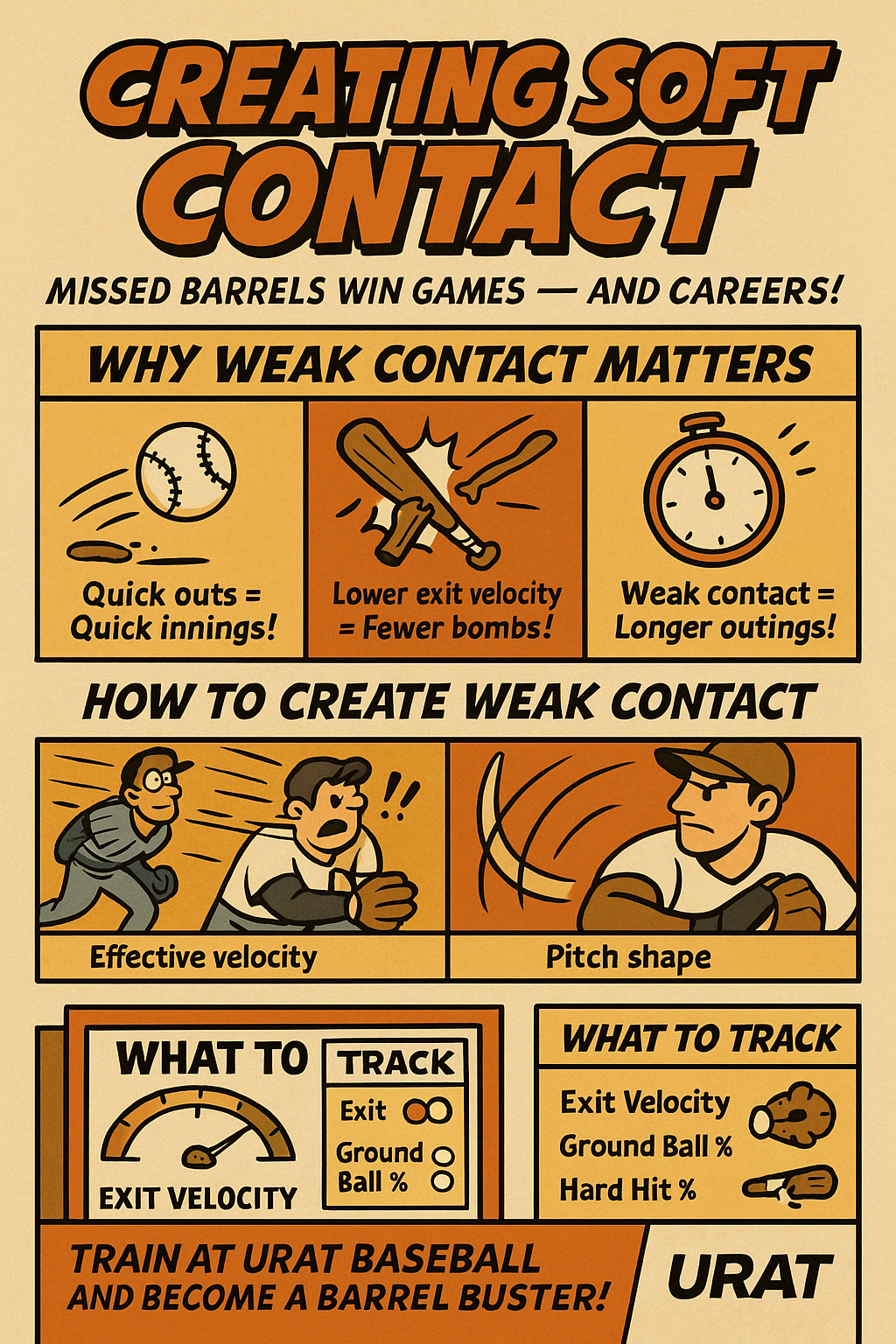
Why Weak Contact Matters

Even the best pitchers only strike out about a third of the hitters they face.
That means the majority of outs — even in the big leagues — happen on balls in play.

  • Weak contact leads to routine ground balls, easy fly balls, and quick innings.

  • Limiting exit velocity reduces the odds of extra-base hits and big innings.

  • Pitchers who force poor contact can throw deeper into games, work more efficiently, and stay healthier by avoiding high-stress innings.

Strikeouts are great. Weak contact is how you survive.


How Scouts and Coaches Evaluate Weak Contact

Scouts and coaches are placing just as much value on a pitcher’s ability to limit exit velocity as they are on raw K/9 numbers.

  • Exit Velocity: Lower is better.

  • Ground Ball Rate: Higher ground ball rates = fewer rallies and fewer big innings.

  • Hard Hit %: Fewer balls barreled at high exit velocity leads to fewer doubles, triples, and home runs.

If a pitcher consistently limits hitters to soft liners, jam shots, and rollover grounders — even without striking everyone out — it’s a major positive.


How You Can Create More Weak Contact

Weak contact isn’t about "throwing slower" — it’s about disrupting timing, location, and swing planes. Here's how elite pitchers consistently miss barrels:

  • Leverage Effective Velocity: Understand how perceived speed changes based on pitch location. A fastball up and in "feels" faster, while an offspeed pitch down and away "feels" slower. Strategic changes in speed and location between pitches maximize weak contact.

  • Adjust Speed and Location: Follow up hard fastballs with slower offspeed pitches in different locations to keep hitters from sitting on one timing window. Good sequencing creates hesitation and bad swings.

  • Increase Pitch Shape Variation: Adding different fastball profiles (sink, ride, run) or refining your breaking ball and offspeed shapes keeps hitters guessing. The more diverse your movement profiles, the harder it is for hitters to square you up.

  • Improve Command Through Biomechanical Efficiency: True command is trained, not just innate. Improving your biomechanics — including your posture, timing, and stability — leads directly to better location, less effort, and more weak contact.

  • Execute with Intent: Every pitch must have a purpose — to either strike the hitter out or force bad contact — not just "hope" for an out.


At URAT Baseball, we train all of these areas:

  • Effective velocity strategy

  • Sequencing and pitch design

  • Pitch shape development

  • Biomechanics-driven command improvement

The goal:
Help you become the type of pitcher who misses barrels as often as you miss bats — and dominate deep into games.


What You Should Track

If you want to level up your game, start tracking:

  • Exit velocity off your fastball and offspeed pitches

  • Ground ball to fly ball ratio

  • Hard-hit percentage (balls off the bat over 90 mph at the MLB level, knowing more about the averages of the level you play at will help)

The lower your average exit velocity and the fewer barrels you allow, the more attention you’ll get from scouts, recruiters, and coaches.


Final Thoughts

Strikeouts end innings.
Weak contact prevents innings from exploding.

If you want to pitch at a high level — and stay there — you need both:
The ability to miss bats and the ability to miss barrels.

Ready to learn how to pitch to weak contact while still attacking with your best stuff?
Contact us for a private evaluation and custom training plan.

jordan@utahrotationalathletetraining.com


Tuesday, April 29, 2025

K/9: Why Strikeouts Matter—And Why You Still Need Weak Contact

K/9: Why Strikeouts Matter—And Why You Still Need Weak Contact

Strikeouts are a cornerstone stat for evaluating pitchers, and that’s why K/9 (strikeouts per 9 innings) is so closely watched by scouts and coaches at every level.

Why Are Strikeouts So Highly Valued?

A strikeout is the cleanest, lowest-risk way to record an out.

  • No defense is needed.

  • Minimal chance of errors(dropped 3rd strikes).

  • No runners can advance on a routine strikeout.

For that reason, K/9 is a major indicator of a pitcher’s ability to control the game. The more outs you can create without putting the ball in play, the less you rely on variables like fielding or umpire judgment.

But Here’s the Reality—Even in MLB:

The average big league pitcher posts about 8.3 strikeouts per 9 innings. That means even at the highest level, roughly 19 outs per game are still made by the defense. Only about a third of outs come from strikeouts.

What This Means for Your Development

Yes, strikeouts are premium currency.
But to become a long-lasting, successful starting pitcher, you must also be able to:

  • Create weak contact: Induce ground balls, pop-ups, and soft fly balls to get quick outs and keep your pitch count low.

  • Mix in strikeouts when you need them most: Two strikes, bases loaded, tight situations—this is where the ability to get a K can save innings.

Pitchers who can blend swing-and-miss stuff with the ability to generate weak contact are the ones who stick around in starting rotations and eat up big innings year after year.

How to Use K/9 in Your Game

  • Track your K/9, but make sure you’re not sacrificing efficiency for strikeouts.

  • Work on sequencing and movement to both finish hitters and get early-count weak contact.

  • Know when to go for the strikeout—and when to pitch to contact for an easy out.


Bottom line:
Strikeouts matter because they guarantee an out—no defense, no risk.
But the secret to longevity as a starter is mastering both: miss bats when you need to, and get weak contact the rest of the way.
This does not mean backing off or throwing with minimal effort to just pitch to contact. It means putting your best stuff in the strike zone as often as possible, trusting your pitches, and attacking hitters—whether you’re looking for a strikeout or a weakly hit ball.

In upcoming posts we will talk about how to develop swing and miss and soft contact stuff through pitch development and biomechanics adjustments.

Want to learn how to balance both and pitch like a pro?
Contact me for a private evaluation or pitching session!

jordan@utahrotationalathletetraining.com


Wednesday, April 23, 2025

Pitcher Grading Groups: What Your Evaluation Really Means


When pitchers are scouted—by college recruiters, MLB teams, or crosscheckers—there’s a shorthand used behind the scenes to group talent. These “Groups” aren’t just about velocity or stats; it is about how they believe you will project at the next level when compared to what the next level actually is.  After years working in both college recruiting and MLB draft rooms, here’s an inside look at the typical Group grading scale and what it means for you.


Group 8: Dominant Ace or Hall of Famer

  • Description: True #1 starter, dominant MLB closer, or future Hall of Famer.

  • Reality: This is the absolute elite. Very few pitchers are ever evaluated here. Think of aces that change the direction of a franchise or closers who own October. 


Group 7: Top of Rotation / Championship Closer / Perennial All-Star

  • Description: #1 or #2 MLB starter, closer for a championship team, perennial all-star.

  • Reality: The front-line arms every organization covets. These are the pitchers who not only perform but do so under the bright lights, year after year.


Group 6: Mid-Rotation Starter or Top Setup

  • Description: Reliable #3 starter, high-leverage setup man (sometimes a closer or 8th-inning reliever for a title team).

  • Reality: Most championship teams are built on these arms. Maybe not superstars, but critical pieces who deliver quality and stability.


Group 5: Back-End Starter / Average Setup / Top Situational

  • Description: #4 or #5 starter, average 7th-inning reliever, or top matchup specialist on a playoff club.

  • Reality: These pitchers fill out winning rosters. They’re capable, sometimes streaky, and may bounce between rotation and bullpen.


Group 4: Long Reliever / Spot Starter / Middle Relief

  • Description: Long reliever, spot starter, or secondary situational arm in middle relief.

  • Reality: Not everyday contributors, but valuable for depth and flexibility. Often called on when the team needs innings.


Group 3: Up-and-Down, Emergency Help

  • Description: Emergency major league help, up-and-down between minors and MLB.

  • Reality: Sometimes called “AAAA” guys—they can fill in when needed, but haven’t secured a permanent spot.


Group 2: Organization Value Only

  • Description: Maxes out at Double-A, serves as depth/filler at Triple-A, not a candidate for the big leagues.

  • Reality: Important for filling rosters in the minors, but unlikely to impact at the MLB level.


Group 1: Non-Prospect

  • Description: No professional value, likely to be released.

  • Reality: The end of the road in pro baseball terms.


Other Grades You Might See

  • G: Did not see (scout did not get a real look at the pitcher).

  • P: Prospect, but not yet ready for major league competition (often a young player with projection).  Players receive a “P” when they are viewed as having higher projection but they still need reps and experience to learn the game. 


What Does This Mean for You?

If you’ve ever received an evaluation and wondered what “Group 4” or “Group 7” really means, this scale is your answer.

  • The higher the group, the more impact you’re projected to make.

  • The lower, the more you’ll need to improve—or the more likely you are to be considered organizational depth.

These grades are not personal—they’re a snapshot of where your tools, command, and performance fit right now. The good news? Players move up and down this scale all the time through development, role changes, and adjustments.  Interested in moving up the grading scale?  Reach out to get your evaluation and lets create a plan for you! 


Want to know your group and what it will take to level up?
jordan@utahrotationalathletetraining.com


Remote Pitching Development: Professional Coaching, No Matter Where You Live

Remote Pitching Development: Professional Coaching, No Matter Where You Live As a parent, you want to give your son every opportunity to suc...