Wednesday, May 14, 2025

BB/9: Why Walks Kill Pitchers (and How to Fix It)


When pitchers are being evaluated, two numbers show up at the top of the report almost every time:

  • K/9: Strikeouts per 9 innings

  • BB/9: Walks per 9 innings

We’ve already covered why strikeouts matter. Now it’s time to talk about the other side — walks, and why BB/9 might be the biggest red flag in a pitcher’s stat line.


What is BB/9 and Why Is It So Important?

BB/9 = Walks per 9 innings pitched.
It tells coaches and scouts one thing: Can you stay in the strike zone consistently?

  • Low BB/9 = trust. You’re a pitcher a coach can keep in the game, call upon in a tight spot, and build a rotation around.

  • High BB/9 = chaos. Walks extend innings, increase pitch count, and flip momentum. They frustrate defenses and lose games at every level.

You can throw 95 mph, but if your BB/9 is high, evaluators will question whether you can survive as a starter — or contribute at all.


A Real-World Example from a College Report

Recently, I was asked to evaluate a local athlete for a collegiate program. In that report, one of the primary concerns I noted was his command and control. Despite flashes of velocity and athleticism, it was clear that his inability to consistently locate led to extended innings and extra pitches.

This wasn't just about walks — it was about what those walks created:

  • More hitters faced

  • More high-stress pitches

  • More opportunities for damage

At the collegiate level, that kind of inefficiency becomes a problem fast. Coaches aren’t just looking for stuff — they’re looking for pitchers they can rely on to stay in the game.


BB/9 Benchmarks by Level

  • Elite: 1.2 – 1.7 BB/9
    Consistently fills up the zone with intent. Rarely gives away free bases and keeps pitch counts low.

  • Average: 2.0 – 2.6 BB/9
    Generally solid command, but may miss spots under pressure or in deep counts.

  • Poor: 3.5+ BB/9
    Walks become part of the game plan for the hitter. Leads to big innings, short outings, and lost trust from coaches.


Why High Walk Rates Happen

  • Inconsistent mechanics = inconsistent release points

  • Lack of intent or conviction in secondary pitches

  • Lack of understanding pitch progressions and selection

  • Fear of contact

  • No plan or rhythm with pitch sequences


How to Lower Your BB/9

1. Improve your mechanics.
Tighten up your movement patterns through biomechanical training. The more stable and repeatable you are, the easier it is to command the zone.

2. Train with pressure.
Use game-like reps with consequences. Simulated innings, 3-ball counts, and command circuits help translate practice into performance.

3. Have a plan.
Know your best pitch in any count. Trust your stuff. Command doesn’t just mean throwing strikes — it means throwing the right strikes.

4. Track your progress.
Just like K/9, BB/9 should be monitored over time. See how it changes between outings and over a season — and match that against how your body feels.


Why BB/9 + K/9 = Your True Pitching Identity

  • High K/9 + Low BB/9 = Dominant starter or closer potential

  • High K/9 + High BB/9 = Wild card — risk/reward arm

  • Low K/9 + Low BB/9 = Pitchability guy — makes hitters earn it

  • Low K/9 + High BB/9 = Major concern

BB/9 tells evaluators how reliable you are.
K/9 tells them how unhittable you are.

When you can do both — miss bats and limit walks — your name stays on every coach’s list.


Final Thoughts

Anyone can miss the strike zone. Great pitchers learn how to attack it.

Strikeouts end innings. Walks extend them.
And if you're not controlling the zone, you're not controlling the game.

Want to improve your BB/9, tighten your command, and start getting real innings?
Let’s get to work. Schedule your private evaluation today.

jordan@utahrotationalathletetraining.com


Wednesday, May 7, 2025

Weak Contact: The Hidden Skill That Dominates the Game


Weak Contact: The Hidden Skill That Dominates the Game

When most people think about elite pitching, they think about strikeouts. And while strikeouts are important (and we've talked about why K/9 matters), the best, most durable pitchers at every level have another weapon:

They limit exit velocity and create weak contact.

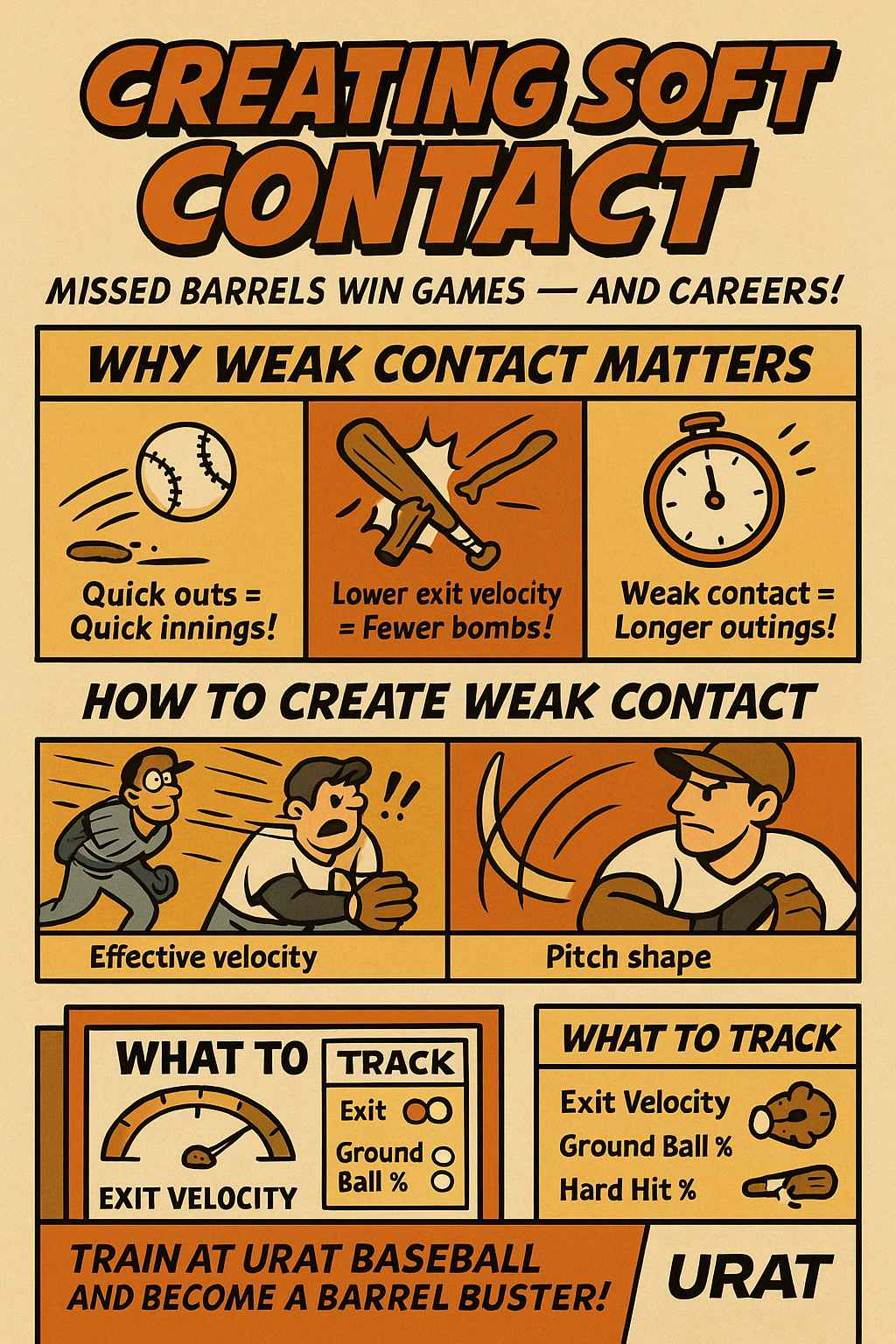
Missed barrels win games — and careers.


Why Weak Contact Matters

Even the best pitchers only strike out about a third of the hitters they face.
That means the majority of outs — even in the big leagues — happen on balls in play.

  • Weak contact leads to routine ground balls, easy fly balls, and quick innings.

  • Limiting exit velocity reduces the odds of extra-base hits and big innings.

  • Pitchers who force poor contact can throw deeper into games, work more efficiently, and stay healthier by avoiding high-stress innings.

Strikeouts are great. Weak contact is how you survive.


How Scouts and Coaches Evaluate Weak Contact

Scouts and coaches are placing just as much value on a pitcher’s ability to limit exit velocity as they are on raw K/9 numbers.

  • Exit Velocity: Lower is better.

  • Ground Ball Rate: Higher ground ball rates = fewer rallies and fewer big innings.

  • Hard Hit %: Fewer balls barreled at high exit velocity leads to fewer doubles, triples, and home runs.

If a pitcher consistently limits hitters to soft liners, jam shots, and rollover grounders — even without striking everyone out — it’s a major positive.


How You Can Create More Weak Contact

Weak contact isn’t about "throwing slower" — it’s about disrupting timing, location, and swing planes. Here's how elite pitchers consistently miss barrels:

  • Leverage Effective Velocity: Understand how perceived speed changes based on pitch location. A fastball up and in "feels" faster, while an offspeed pitch down and away "feels" slower. Strategic changes in speed and location between pitches maximize weak contact.

  • Adjust Speed and Location: Follow up hard fastballs with slower offspeed pitches in different locations to keep hitters from sitting on one timing window. Good sequencing creates hesitation and bad swings.

  • Increase Pitch Shape Variation: Adding different fastball profiles (sink, ride, run) or refining your breaking ball and offspeed shapes keeps hitters guessing. The more diverse your movement profiles, the harder it is for hitters to square you up.

  • Improve Command Through Biomechanical Efficiency: True command is trained, not just innate. Improving your biomechanics — including your posture, timing, and stability — leads directly to better location, less effort, and more weak contact.

  • Execute with Intent: Every pitch must have a purpose — to either strike the hitter out or force bad contact — not just "hope" for an out.


At URAT Baseball, we train all of these areas:

  • Effective velocity strategy

  • Sequencing and pitch design

  • Pitch shape development

  • Biomechanics-driven command improvement

The goal:
Help you become the type of pitcher who misses barrels as often as you miss bats — and dominate deep into games.


What You Should Track

If you want to level up your game, start tracking:

  • Exit velocity off your fastball and offspeed pitches

  • Ground ball to fly ball ratio

  • Hard-hit percentage (balls off the bat over 90 mph at the MLB level, knowing more about the averages of the level you play at will help)

The lower your average exit velocity and the fewer barrels you allow, the more attention you’ll get from scouts, recruiters, and coaches.


Final Thoughts

Strikeouts end innings.
Weak contact prevents innings from exploding.

If you want to pitch at a high level — and stay there — you need both:
The ability to miss bats and the ability to miss barrels.

Ready to learn how to pitch to weak contact while still attacking with your best stuff?
Contact us for a private evaluation and custom training plan.

jordan@utahrotationalathletetraining.com

Remote Pitching Development: Professional Coaching, No Matter Where You Live

Remote Pitching Development: Professional Coaching, No Matter Where You Live As a parent, you want to give your son every opportunity to suc...